LC: 308. Range Sum Query 2D (Mutable)
https://leetcode.com/problems/range-sum-query-2d-mutable/
308. Range Sum Query 2D - Mutable
Given a 2D matrix matrix, handle multiple queries of the following types:
Update the value of a cell in
matrix.Calculate the sum of the elements of
matrixinside the rectangle defined by its upper left corner(row1, col1)and lower right corner(row2, col2).
Implement the NumMatrix class:
NumMatrix(int[][] matrix)Initializes the object with the integer matrixmatrix.void update(int row, int col, int val)Updates the value ofmatrix[row][col]to beval.int sumRegion(int row1, int col1, int row2, int col2)Returns the sum of the elements ofmatrixinside the rectangle defined by its upper left corner(row1, col1)and lower right corner(row2, col2).
Example 1:
Input
["NumMatrix", "sumRegion", "update", "sumRegion"]
[[[[3, 0, 1, 4, 2], [5, 6, 3, 2, 1], [1, 2, 0, 1, 5], [4, 1, 0, 1, 7], [1, 0, 3, 0, 5]]], [2, 1, 4, 3], [3, 2, 2], [2, 1, 4, 3]]
Output
[null, 8, null, 10]
Explanation
NumMatrix numMatrix = new NumMatrix([[3, 0, 1, 4, 2], [5, 6, 3, 2, 1], [1, 2, 0, 1, 5], [4, 1, 0, 1, 7], [1, 0, 3, 0, 5]]);
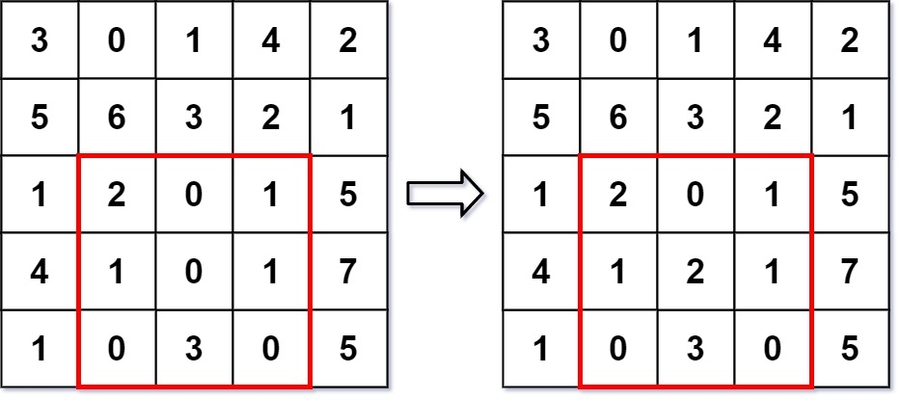
numMatrix.sumRegion(2, 1, 4, 3); // return 8 (i.e. sum of the left red rectangle)
numMatrix.update(3, 2, 2); // matrix changes from left image to right image
numMatrix.sumRegion(2, 1, 4, 3); // return 10 (i.e. sum of the right red rectangle)Constraints:
m == matrix.lengthn == matrix[i].length1 <= m, n <= 200-105 <= matrix[i][j] <= 1050 <= row < m0 <= col < n-105 <= val <= 1050 <= row1 <= row2 < m0 <= col1 <= col2 < nAt most
104calls will be made tosumRegionandupdate.
308. Range Sum Query 2D - Mutable:
The Essence:
Wir haben einige Implementationen in dem entsprechenden PR. Die Essenz all dieser Lösungen ist in der Tat "Modularisierung". Nämlich, wir können das Array in Intervalle einteilen. Damit können wir die Werte eines Intervall so aktualisieren, so dass die unabhängigen Intervalle davon nicht beeinflusst werden.
Details:
Die dafür geeigneten Datenstrukturen sind der Segmentbaum und der Fenwicktbaum. Die beiden Implementationen sowie ausführlichere Erläuterungen sind in unserem PR zu finden.
Default Code:
Last updated