LC: 489. Robot Room Cleaner
https://leetcode.com/problems/robot-room-cleaner/
489. Robot Room Cleaner
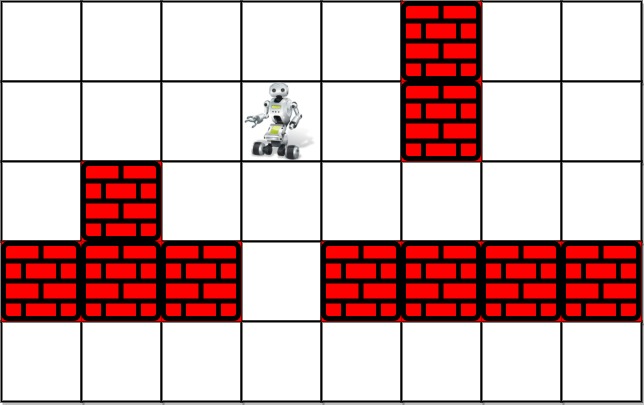
You are controlling a robot that is located somewhere in a room. The room is modeled as an m x n binary grid where 0 represents a wall and 1 represents an empty slot.
The robot starts at an unknown location in the root that is guaranteed to be empty, and you do not have access to the grid, but you can move the robot using the given API Robot.
You are tasked to use the robot to clean the entire room (i.e., clean every empty cell in the room). The robot with the four given APIs can move forward, turn left, or turn right. Each turn is 90 degrees.
When the robot tries to move into a wall cell, its bumper sensor detects the obstacle, and it stays on the current cell.
Design an algorithm to clean the entire room using the following APIs:
interface Robot {
// returns true if next cell is open and robot moves into the cell.
// returns false if next cell is obstacle and robot stays on the current cell.
boolean move();
// Robot will stay on the same cell after calling turnLeft/turnRight.
// Each turn will be 90 degrees.
void turnLeft();
void turnRight();
// Clean the current cell.
void clean();
}Note that the initial direction of the robot will be facing up. You can assume all four edges of the grid are all surrounded by a wall.
Custom testing:
The input is only given to initialize the room and the robot's position internally. You must solve this problem "blindfolded". In other words, you must control the robot using only the four mentioned APIs without knowing the room layout and the initial robot's position.
Example 1:
Example 2:
Constraints:
m == room.lengthn == room[i].length1 <= m <= 1001 <= n <= 200room[i][j]is either0or1.0 <= row < m0 <= col < nroom[row][col] == 1All the empty cells can be visited from the starting position.
The Essence:
Der Roboter soll natürlich in 4 Richtungen suchen. Nachdem er eine Richtung vollständig sucht, soll er zu dem vorherigen Punkt zurückkehren und andere 3 Richtungen suchen.
Details:
Die Bewegung des Roboters entspricht einem Algorithmus mit DFS-Backtracking. Die Menge der durchgelaufene Punkte kann man mit hilfe einer Hashmenge speichern. Die Endbedingung des Backtracking ist die Tatsache, dass der Roboter sich in einer Richtung nicht bewegen kann. Wenn dies der Fall ist, dann soll der Roboter umdrehen und sich bewegen, dann wieder umdrehen. Damit kehrt er zu seiner ursprünglichen Position zurück.
Solution(s) and Further Explanation:
Default Code:exit: Ctrl+↩
Last updated